|
| John Bloomfield Jervis, 1877 |
The following biographical information is presented from the Rome Library website with permission:
John B. Jervis (1795-1885) was America's leading consulting engineer of the antebellum era (1820 - 1860). Jervis was a pioneer in the development of canals and railroads for the expanding United States. He designed and supervised the construction of five of America's earliest railroads, was chief engineer of three major canal projects, designed the first locomotive to run in America, designed and built the forty-one mile Croton Aqueduct (New York City's water supply for fifty years: 1842 - 1891), and the Boston Aqueduct. Jervis authored a book on economics, The Question of Labor and Capital (1877); helped found a local industry, the Rome Iron Mills; and, of course, is the founder of Rome's public library.
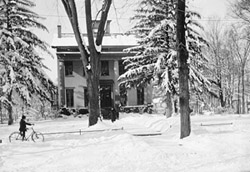 Jervis bequeathed his home and personal library to the city of Rome, New York, to be used as a public library. His personal library is kept intact as a memorial and for research purposes. The papers of John Jervis number in the thousands, and include memoirs, manuscripts of books he authored, scrapbooks, folios and quartos, nearly 600 engineering plans and drawings (some in watercolor), maps, public documents, and countless letters and reports. His library also includes 1,800 monograph volumes on general topics as well as a concentration on applied sciences and civil engineering. Copyrights and dates of publication range from the 1670's through the 1880's.
Jervis began his career in Rome as an Axeman for an Erie Canal survey party in 1817. By 1823 he was superintendent of a fifty-mile section of the Erie Canal. In 1827 he was appointed Chief Engineer of the Delaware and Hudson Canal project. It was John Jervis who suggested that a railroad be incorporated into this project. At this time there were no railroads in America, but Jervis won approval of his idea and even designed the railroad's locomotive, the Stourbridge Lion, the first locomotive to run in America. In honor of his work on the Delaware and Hudson, Port Jervis, N.Y., is named for him.
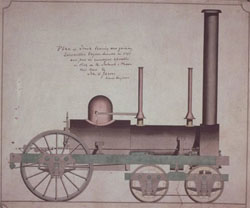 In 1830, as Chief Engineer of the Mohawk & Hudson Railway (the first section of what was later to be the N.Y. Central R. R.), Jervis designed "The Experiment." This was the first locomotive in the world to have a free-swinging, four-wheel front truck, which gave the vehicle greater maneuverability and enabled it to travel at an unprecedented speed of eighty miles per hour. The Jervis design became the standard American design.
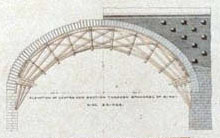
The monumental task of building New York City's forty-one mile water-supply system (The Croton Aqueduct) was given to Jervis in 1836. The system included the Croton Dam, the Ossining Bridge, the Harlem River Bridge, the Receiving, Equalizing, and Distributing Reservoirs on Manhattan, as well as the magnificent embankments, tunnels, and arches employed throughout the aqueduct system. (Original illustrations and engravings of these structures are preserved in the Smithsonian Institution and in the Library of Congress). The six-year project employed over 4,000 workers, and when completed, carried seventy-five million gallons daily to New York City.
 Jervis's other notable contributions include the design and construction of the following: the ninety-eight mile Chenango Canal (1833), the enlargement of the eastern division of the Erie Canal (1834), the Boston water supply project (1846), the Hudson River R. R. (1847-1850), the Michigan Southern & Northern Indiana R.R., the Chicago & Rock Island R.R. (1850 - 1858), and he was general Superintendent of the Pittsburgh, Fort Wayne & Chicago Railway (1861-64). Again, we must stress that these undertakings were "pioneering" ventures. Jervis's projects were filled with "first" and "untried" engineering principles, and as such, were "schools" for a generation of American civil engineers.
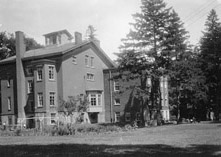 Jervis returned home to Rome in 1864. In 1869 he organized the Merchants Iron Mill, which survives today as the Rome Iron Mill. He spent the remainder of his life writing and in 1877 published a book on economics, The Question of Labor and Capital. Upon his death he bequeathed a large portion of his estate to the city of Rome for a library. His personal library remains as a special collection in Rome's Jervis Library. A Library of Congress representative noted that it is one of the most complete sets of early railroad and canal reports and maps in existence.
^v^v^v^v^v^v^v^v^v^
Note here that while it is not clear from the material above, John B. Jervis was a self educated man. He did not attend any institution of higher education. In fact, there is no evidence that he ever completed his secondary education.
According to Lori Chien of the Rome Library, "He apprenticed with Benjamin Wright on the Erie Canal and learned on the job, and also read widely on his own. You may be interested in reading these two books about his life: "The Reminiscences of John B. Jervis, Engineer of the Old Croton," and "John B. Jervis: An American Engineering Pioneer" by F. Daniel Larkin. ... Please note that the Jervis papers are open to qualified researchers by appointment only, which needs to be made at least two weeks in advance."
Like many other Enlightened individual of that era like Joseph Priestley, who has been written about extensively, John Jervis demonstrated that a formal education was not necessarily a requirement for significant scientific and technological contributions. Individuals like Jervis and Priestley can teach us much about the human mind and how profound understanding of knowledge can be acquired as a basis for creative thought by just about anyone.
The Ossining Museum in Ossining NY has a delightful exhibit on the Old Croton Aqueduct and John B Jervis. They also have a great exhibit on the history of the local prison (sometimes referred to as Sing Sing, or the Big House). We highly recommend a visit there if you are in the area for both of the exhibits.
 |
| Stock Certificate signed by John Jervis. Michigan Southern Railroad Company |
last modified 12/25/22